This Is What Happens When You Slow Down in Pokhara
You know that feeling when you’re constantly chasing checklists, snapping photos, and rushing to the next spot? I did too—until I slowed down in Pokhara. Nestled beside a serene lake with the Himalayas watching silently, this place changed how I travel. It’s not about ticking boxes; it’s about moments. Sunrises that take your breath away, quiet boat rides at dawn, and mountain views that feel almost too real. This is slow travel at its purest—and honestly, it’s the only way to truly see Pokhara.
The Allure of Pokhara: More Than Just a Gateway to the Himalayas
Pokhara is not just another stop on the Nepali tourist trail. It is a place where nature and stillness converge in a way that feels both rare and deeply comforting. Located in central Nepal, about 200 kilometers west of Kathmandu, Pokhara sits in a broad valley surrounded by forested hills and guarded by the towering Annapurna range. At its heart lies Phewa Lake, a mirror-like body of water that reflects the sky and mountains with near-perfect clarity. This natural beauty is not staged or filtered—it is immediate, accessible, and profoundly calming.
While many travelers arrive in Pokhara as a starting point for treks to Annapurna Base Camp or the Poon Hill route, the city itself offers far more than logistical convenience. It has a rhythm all its own, shaped by the soft lapping of lake waves, the distant chime of temple bells, and the unhurried pace of daily life. Unlike bustling Kathmandu or crowded Bhaktapur, Pokhara does not demand attention. Instead, it invites presence. The air is fresher, the skies often clearer, and the sense of space more generous. It is a destination that rewards patience and rewards those who choose to linger.
Phewa Lake is central to Pokhara’s identity. Spanning over four square kilometers, it serves as both a scenic centerpiece and a living space where locals fish, boatmen earn their livelihood, and children play along the shore. The lake’s calm surface, especially at dawn, creates a dreamlike atmosphere. Across the water, the golden peak of Machhapuchhre—known as the “Fishtail Mountain”—rises with a near-sacred presence. Revered by the local Gurung people, this unclimbed summit remains untouched by human ascent, adding to its mystical aura. Its reflection shimmering on the lake is not just a photo opportunity; it is a moment of quiet awe that only unfolds when you are still enough to witness it.
The climate in Pokhara enhances its appeal. With mild temperatures year-round and distinct dry and monsoon seasons, it offers ideal conditions for outdoor exploration. The city receives more rainfall than most parts of Nepal, which keeps the hills lush and green, especially from June to September. However, the best times to visit are autumn (September to November) and spring (March to May), when skies are clear, visibility is excellent, and the mountain views are at their most dramatic. During these months, the air is crisp, the sun warm but not harsh, and the trails are dry and safe for walking. These conditions naturally support a slower, more immersive kind of travel—one where you can spend hours by the lake or on a hillside without feeling rushed or uncomfortable.
Why Slow Travel Fits Pokhara Perfectly
Slow travel is not just a trend; it is a mindset. It means resisting the urge to pack every hour with activities, to document every moment for social media, or to treat a destination like a checklist. In Pokhara, this philosophy doesn’t just make sense—it feels inevitable. The city’s atmosphere gently discourages haste. There are no grand museums to race through, no long lines to join, no need to book tickets weeks in advance. Instead, the rewards come from presence: sitting quietly, listening, observing, and allowing experiences to unfold naturally.
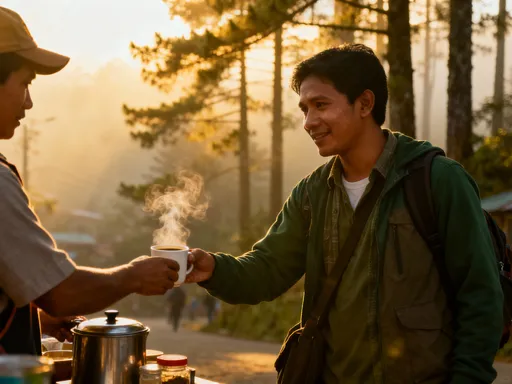
Imagine spending two full hours at a small café overlooking Phewa Lake, sipping a cup of Nepali tea—milky, spiced with cardamom, and served in a thick ceramic mug. The sun moves slowly across the sky. A fisherman paddles by in a wooden boat. A group of schoolchildren laugh as they skip stones near the shore. You feel no pressure to move on. There is nowhere else you need to be. This is the essence of slow travel: finding richness in stillness, depth in simplicity, and connection in observation.
Another example is walking barefoot through the grassy hills behind the city. The ground is soft, cool beneath your feet, dotted with wildflowers and the occasional grazing goat. You pause often—not because you are tired, but because you want to take in the view, to breathe deeply, to notice how the light changes on the mountains as the day progresses. There is no destination marked on a map, no photo op you’re chasing. You are simply moving with intention, allowing the landscape to speak to you at its own pace.
What makes Pokhara especially suited to this way of traveling is its balance of accessibility and tranquility. You can be in the heart of Lakeside, the tourist hub with restaurants, shops, and guesthouses, and within a 15-minute walk, find yourself in near solitude on a quiet trail or a secluded beach along the lake. This ease of access to both comfort and nature removes the stress that often accompanies travel. You don’t need to plan every minute. You can follow your curiosity, let your body set the rhythm, and trust that the city will reveal its beauty in due time.
The emotional payoff of this approach is significant. When you slow down, you begin to notice details you would otherwise miss—the way mist curls over the lake in the early morning, the sound of a distant flute from a temple courtyard, the warm smile of a local woman selling handmade baskets. These moments do not add up to an itinerary; they add up to a memory. And that memory is not of what you did, but of how you felt—calm, connected, and deeply present.
Sunrise at Sarangkot: A Moment Worth Waking Up For
If there is one experience that embodies the spirit of slow travel in Pokhara, it is watching the sunrise from Sarangkot. Perched on a ridge about ten kilometers west of the city, this vantage point offers one of the most breathtaking views in Nepal. On a clear morning, the first light touches the snow-covered peaks of the Annapurna range—Annapurna South, Machhapuchhre, and Hiunchuli—painting them in hues of pink, gold, and deep orange. The sight is so powerful, so quietly majestic, that it can bring tears to your eyes.
But the magic of Sarangkot is not just in what you see—it is in how you get there and how you wait. The journey begins before dawn. Most travelers take a private jeep or join a small group tour from Lakeside, leaving around 4:30 or 5:00 a.m. The drive is winding and dark, the road narrow and unpaved in places, but the anticipation builds with every turn. As you climb higher, the city lights fade behind you, and the sky begins to lighten in the east. By the time you reach the top, the air is crisp, often below 10°C, and the silence is profound.
Arriving early allows you to settle in, to breathe, and to prepare for the moment without rushing. You find a spot on the stone viewing platform, wrap yourself in a scarf or jacket, and simply wait. There is no crowd control, no ticket system, no loudspeaker announcements. You are free to stand, sit, or crouch as you please. Around you, others do the same—travelers from Japan, Germany, Australia, and beyond—all united in quiet anticipation. There are no loud conversations, no phone calls. Just the occasional whisper, the click of a camera, or the soft rustle of a windbreaker.
Then, slowly, the light begins to change. A faint glow appears on the highest peaks. The shadows retreat. The sky shifts from deep indigo to soft lavender, then to pale gold. And then—almost imperceptibly at first—the sun crests the horizon, and the mountains ignite. It happens in silence. No one claps. No one speaks. Everyone simply watches, some with tears in their eyes, all aware that they are witnessing something fleeting and sacred.
To make the most of this experience, timing is essential. The best months for clear skies are October to December and March to May. Arriving at least 30 to 45 minutes before sunrise ensures you have time to find a good spot and acclimate to the cold. While some visitors opt for paragliding from Sarangkot at dawn—a thrilling alternative—it is the quiet, grounded act of waiting that aligns most closely with slow travel. There is no need to chase adrenaline when awe is already within reach.
Phewa Lake: Stillness in Motion
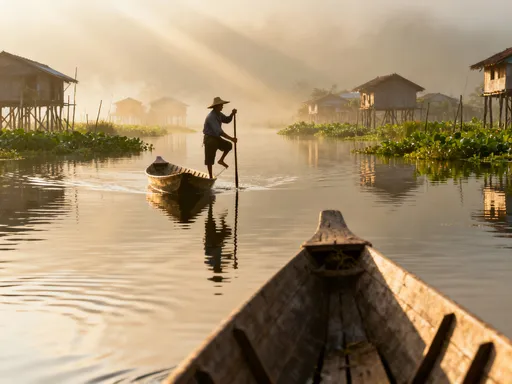
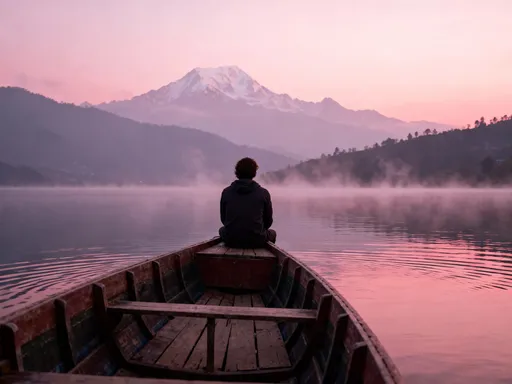
Phewa Lake is the soul of Pokhara. More than just a scenic backdrop, it is a living, breathing part of daily life. For travelers, it offers a rare opportunity to move slowly through a landscape of quiet beauty. One of the most peaceful ways to experience the lake is by rowboat. Unlike motorized boats, which are few and mostly used for transport, traditional wooden rowboats glide silently across the water, powered only by gentle strokes of an oar.
Imagine setting out just after sunrise. The lake is smooth as glass. The air is cool, carrying the scent of damp earth and lotus blossoms. You sit in the boat, wrapped in a woolen blanket, as the boatman rows with quiet skill. There is no rush. No set route. You move where the light is best, where the reflection of Machhapuchhre is clearest. Kingfishers dart across the surface. A heron stands motionless in the shallows. Ducks paddle lazily near the shore. Time slows. Your breath deepens. Your thoughts quiet.
Midway across the lake stands Tal Barahi Temple, a two-story pagoda built on a small island. Dedicated to a form of the goddess Durga, it is a place of worship and serenity. Many visitors choose to land and walk among the stone steps and prayer flags, but even viewing it from a distance adds to the sense of peace. The temple appears to float on the water, its red and gold roof glowing in the morning sun. There is no need to enter, no need to take a photo. Sometimes, just seeing it is enough.
Spending unhurried time on the lake changes your perception. You stop seeing it as a tourist attraction and begin to feel it as a living space—a place where nature, culture, and stillness intersect. You notice how the water changes color throughout the day: deep blue at dawn, shimmering silver at noon, soft gold at sunset. You learn to read the wind by the ripples on the surface. You become attuned to the rhythms of the lake, just as the locals are.
For those who wish to go deeper, early morning meditation or journaling by the shore can be transformative. Sitting on a bench or a low wall, watching the world wake up, you may find yourself more present than you’ve been in months. The lake does not demand anything of you. It simply exists, and in its presence, you remember how to do the same.
Hidden Hillside Trails: Where Views Come Slowly
While Sarangkot and the lakeside are well-known, some of the most rewarding experiences in Pokhara come from lesser-traveled paths. The hills surrounding the city are laced with quiet trails that lead to panoramic viewpoints, small temples, and forest clearings. Two of the most accessible are the routes to the World Peace Pagoda and Australian Camp, both offering stunning views without the crowds.
The walk to the World Peace Pagoda, a white Buddhist stupa perched on Anadu Hill, begins from the southern shore of Phewa Lake. The trail is well-marked, climbing steadily through dense forest. As you ascend, the sounds of the city fade. Birds call from the trees—bulbuls, magpies, and the occasional Himalayan cuckoo. The air grows cooler. Every few minutes, the trees part, revealing glimpses of the lake below and the mountains beyond. It is not a difficult hike, but it is not rushed. You walk at your own pace, pausing to drink water, to catch your breath, to take in the view.
When you reach the pagoda, the reward is immediate. From this vantage point, you can see the entire sweep of Pokhara Valley, Phewa Lake like a blue jewel, and the Annapurna range standing tall in the distance. Prayer flags flutter in the wind, carrying blessings across the hills. Visitors sit in silence, meditating or simply gazing. There is no entrance fee, no commercial activity—just peace.
Another quiet trail leads to Australian Camp, a former rest point for foreign trekkers during the 1960s. The path begins near the northern end of the lake and winds through terraced fields and small villages. Along the way, you pass farmers tending their crops, children walking home from school, and elders sitting in doorways. The trail is not always clearly marked, but that is part of its charm. Getting slightly lost, asking for directions in broken Nepali, sharing a smile with a local—these are the moments that make travel meaningful.
Both trails emphasize the journey over the destination. You do not come here for a trophy view or a social media post. You come to walk, to breathe, to be present. Each step becomes a form of meditation. The physical act of moving through nature—feeling the earth beneath your feet, listening to the wind, noticing the play of light and shadow—grounds you in the moment. And when the view finally opens up, it feels earned, not given.
Local Encounters: Seeing Through Local Eyes
Slow travel is not only about landscapes; it is also about people. In Pokhara, some of the most memorable moments come not from grand sights, but from small, unplanned interactions. These are not staged cultural performances or tourist shows. They are real, fleeting, and deeply human.
One morning, while walking along the eastern shore of Phewa Lake, I met an elderly fisherman mending his net. He sat on a low rock, his hands moving with practiced ease. I stopped to watch. He looked up, smiled, and gestured for me to sit. We did not speak the same language, but he offered me a piece of dried fruit from his bag. We sat in silence for a while, watching the water. When he finished, he pointed to his boat and mimed rowing. I nodded. He smiled again and walked away. That moment—simple, wordless, kind—stayed with me longer than any mountain view.
Elsewhere, in a small market near the old bazaar, I watched a woman weave a basket from river reeds. Her fingers moved quickly, weaving and tightening with precision. I admired her work. She held it up, then handed it to me to feel. I bought it, not because I needed a basket, but because I wanted to honor her craft. She did not haggle. She accepted the price with a quiet nod. These exchanges—based on respect, not transaction—are what slow travel makes possible.
Walking through a village near Australian Camp, I passed a group of children on their way to school. They wore matching blue uniforms and carried small backpacks. One girl dropped her notebook. I picked it up and handed it back. She smiled, said “Dhanyabad,” and ran to catch up with her friends. That smile—bright, genuine, unguarded—was a gift.
These moments are not unique to Pokhara, but they are more accessible here because of the city’s pace. When you are not rushing, you notice people. You make eye contact. You slow down enough to see them, not just as part of the scenery, but as individuals with lives, stories, and kindness to share. And in return, you are seen—not as a tourist, but as a fellow human being.
When to Go and How to Stay: Practical Slow Travel Tips
To truly embrace slow travel in Pokhara, planning matters—not in terms of rigid schedules, but in thoughtful preparation. The best time to visit is during the shoulder seasons: autumn (September to November) and spring (March to May). During these months, the weather is stable, the skies are clear, and the mountain views are at their most vivid. Monsoon season (June to August) brings heavy rain and landslides, while winter (December to February) can be chilly, especially at higher elevations.
Stay for at least four to five days. This allows time to settle in, to explore without pressure, and to experience the rhythm of the city. Rushing through in two or three days means you’ll only scratch the surface. With more time, you can return to the same café, walk the same trail at different times of day, and let the place reveal itself gradually.
Choose accommodations that support stillness. Lakeside guesthouses with view balconies are ideal. Look for places with large windows, quiet rooms, and outdoor seating. Waking up to the sight of the lake and the mountains is a daily gift. Avoid loud hostels or party-oriented hotels if you seek peace. Instead, opt for family-run lodges where the owners greet you by name and offer homemade meals.
Create simple routines. Begin each day with a walk along the lakefront. Have breakfast at a quiet café. Spend the afternoon reading under a tree or writing in a journal. Take a boat ride at sunset. In the evening, stroll through the bazaar, sample local food, and listen to street musicians. These small rituals anchor your stay and deepen your connection to the place.
Finally, consider unplugging. Put your phone on airplane mode for a few hours each day. Leave the camera in your bag. Let yourself experience the moment without filtering it through a lens. The best memories are not the ones you capture—they are the ones you live. And in Pokhara, when you slow down, you begin to see not just with your eyes, but with your whole self.
The true beauty of Pokhara is not just in its mountains, its lake, or its sunrises. It is in the way it teaches you to see. Slow travel is not a luxury; it is a return to awareness. In a world that moves too fast, Pokhara offers a rare gift—the chance to really look, to breathe, and to remember why we travel in the first place.